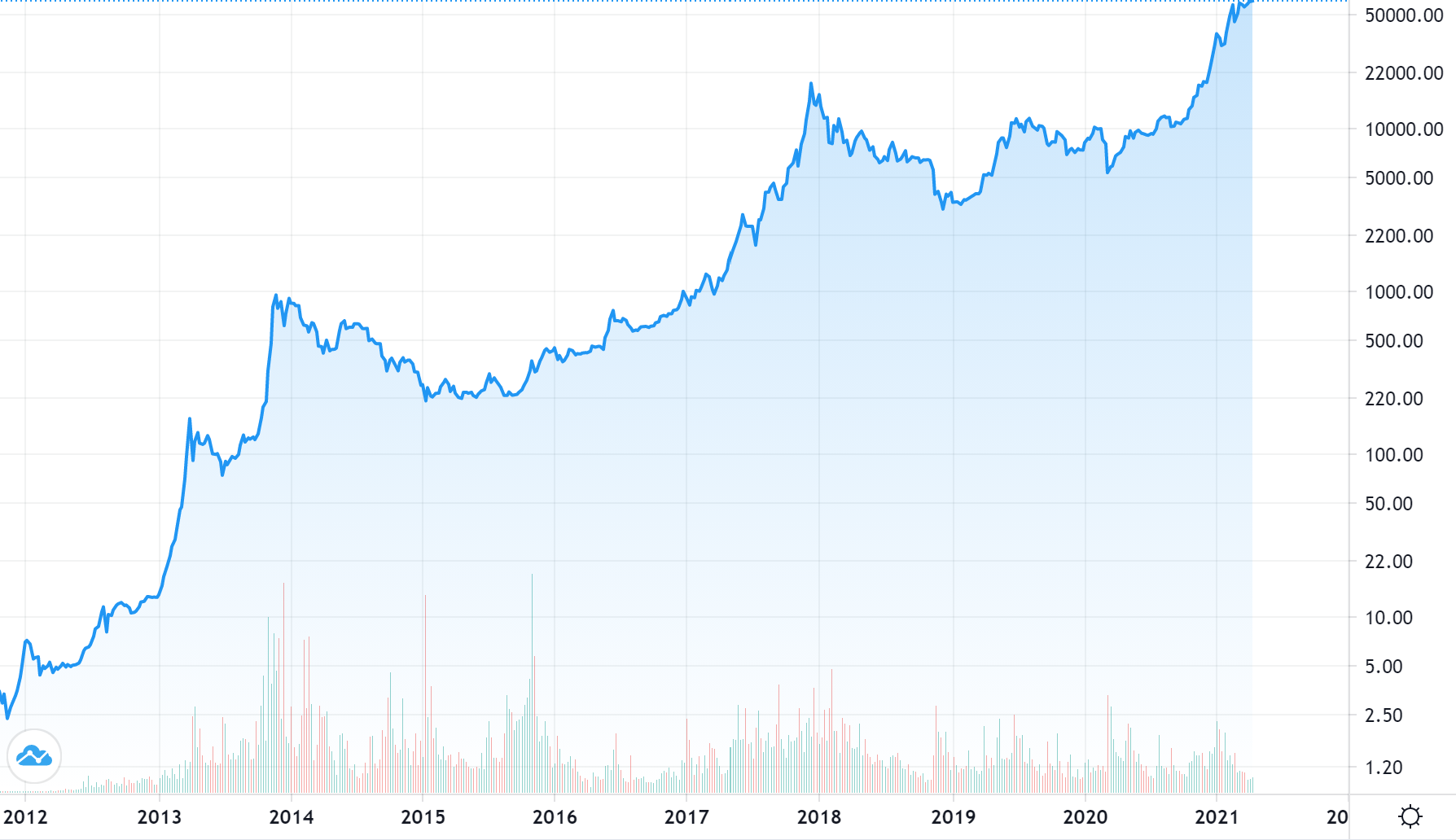
In my last post I described in microeconomic terms why the prices of popular cryptocurrencies are likely inflated. I glossed over the nuances of different cryptocurrencies, even though I referenced a price history of Bitcoin ("BTC"), which is presently the largest. But not all cryptocurrencies are the same: Some are pegged to assets, and some like BTC have a floating value. The runaway price of BTC in particular has led to some unintended consequences that confirm the hypothesis that it is in a speculative bubble.
The real effect of increasing a floating cryptocurrency’s price is to attract more distributed computing power – a.k.a. “miners” – to its blockchain. At present there are two kinds of blockchains: “Proof of Work” (PoW) and “Proof of Stake” (PoS). A PoW currency is provably secure so long as no single organization can acquire more than half of the miners. PoW is elegant in theory. BTC is essentially a PoW blockchain that happens to pay miners in its associated currency. What seemed good in a whitepaper has turned out to be an inefficient mechanism for regulating the mining power used by the blockchain. It wasn’t until the past few years that we discovered how far unthrottled PoW could spin out of control.
Can a cryptocurrency waste computing power? BTC evangelists argue that there’s no such thing as too many miners: More miners means more security. That’s sort of true, but at some point it loses meaning because hijacking the blockchain requires a single entity to run more computing power than all of the other miners combined – and likely to continuously fend off the counterattacks of all of the blockchain stakeholders. And how much computing power are we talking about? In 2017, when the price of BTC surpassed $1,000, the cost of electricity required to mine one dollar of BTC exceeded the cost of mining precious metals. And here’s the problem: The resources devoted to mining grow linearly with the price of BTC. Double the price of BTC and miners will profitably spend roughly twice as much working its blockchain. When BTC traded over $25,000 it was estimated that the energy devoted to running its blockchain exceeded the energy used by many developed countries. The demand for mining hardware has created such shortages of GPUs that NVidia tried more than once to cripple its high-end graphics cards so that they couldn’t be used for mining. With BTC trading over $50,000, miners are burning on the order of $50MM per day working its blockchain.
What is the right level of mining to secure a blockchain? No matter the answer, it’s almost certain that BTC is exceeding that level: Nobody is bidding up the price of BTC because they think, “I need to pay more to ensure the BTC blockchain is secure!” On the contrary, it is speculation in BTC that is driving the resources devoted to mining. BTC bulls argue that the increase in mining (and hence security) is increasing the value of BTC. So who’s to say BTC mining is “too high?” The BTC specification itself gives us this result: Presently BTC miners are paid with a combination of transaction fees and new BTC. By design, the creation of new BTC is limited and will phase out, so transaction fees are what will sustain the blockchain in the long run. In the short run, with BTC priced over $50,000 the new BTC created by mining pays miners more than 10 times as much as does the transaction fee. But this source of compensation will go away! Transaction fees alone will determine the long-term level of mining. Will BTC users pay $50MM or more per day in fees to miners? If not then the current level of mining is higher than necessary to secure the blockchain.
Bitcoin "investors" are not buying BTC at this price with the goal of increasing the amount of mining. Rather, miners are devoting these excessive levels of resources to mining because BTC is presently priced so high. Nobody has calibrated the BTC price to the cost of work, and in the long run there is no necessary relationship between the two because mining will not be compensated with BTC. This fits the definition of a bubble. It could be a bubble in consumption of mining power, a bubble in the price of BTC, or both.